



DEVELOPMENT IN COMPANIES
Complexity is increasing disproportionately and extensively in all areas.
- Market requirements (innovation, AI, political requirements, environment, sustainability)
- Increasing product complexity and variety with shorter product life cycles and innovation cycles
- More and more unpredictable and incalculable influencing factors with interactions in the value chain and stakeholder network
- Constantly changing conditions
- Estimating and anticipating future series prices for procurement volumes increasingly difficult

Resource consumption is increasing in all areas of the company, across the entire value chain, and also in the stakeholder network.
Volume of data, number of IT systems
Number and scope of organizational units especially in “indirect areas” is steadily increasing
Administrative costs are rising disproportionately
The number of “duplicates,” redundancies, and potential errors is increasing noticeably (e.g., standard components are managed with different item numbers in different systems).


Decisions in complex organizational units with many levels, processes, and interfaces are made on the basis of incomplete, incorrect, and sometimes contradictory information.
“Objectified subjectivity” as a basis for decision-making in product management consideration
Decision times and coordination loops are becoming longer and larger.
It is never possible to have all possible alternatives “clearly evaluated” as a basis for decision-making.

The profit margin erodes over time and cannot be maintained until series production begins. not be maintained
Scope of supply (materials, components, assemblies, etc.) is not available in time for SOP/series production.
No solution for the product development process (PLC) that can display the current status of all product-related information at any time (e.g., material or part price, margin, part availability, schedule deviations, missing certifications, approvals, and much more).
A multitude of systems, software, interface problems, access authorizations, inconsistent processes, data and information loss
To date, there is no fully integrated, cross-process software solution that bundles, aggregates, and displays all product-related information and ensures the secure and smooth running of the necessary development processes, even though numerous crises, such as the economic crisis of 2009 or COVID-19 in 2020, have shown that there is an urgent need to initiate and implement systematic safeguarding measures in this area. Implementation
THE COMPANY

- Volker P. Zimmerer MBA decides in 2024 to collaborate on the development of neural, AI-supported, integrative software analysis solutions based on the “big data approach.”
- An existing company is renamed Enterprise Analytics Software GmbH.
- The German sales company is based in Ellwangen, sharing its premises with the C/O Z management consulting & holdings (ZMC), owned by Volker P. Zimmerer.
CUSTOMERS AND MARKETS
Our software solutions are suitable for customers in a wide range of markets. As a general rule, the more complex the following points are, the greater the potential leverage:
- The products themselves are sufficiently complex (consisting of many assemblies and components).
- There are a large number of product variants or derivatives.
- The procurement structure is complex (large number of suppliers and a wide variety of procurement volumes).
- Products are created as part of a typical, multi-stage product development/product creation process. The product is developed, at least in the value chain network, together with the customer and the supplier, to series production readiness or until the plant is completed
- The product can be manufactured on a make-to-order or mass production basis (e.g., cruise ships, large-scale plants, commercial vehicles, motor vehicles, assemblies, or components from 0.5-tier, 1st-tier, or 2nd-tier suppliers).
INDUSTRIES
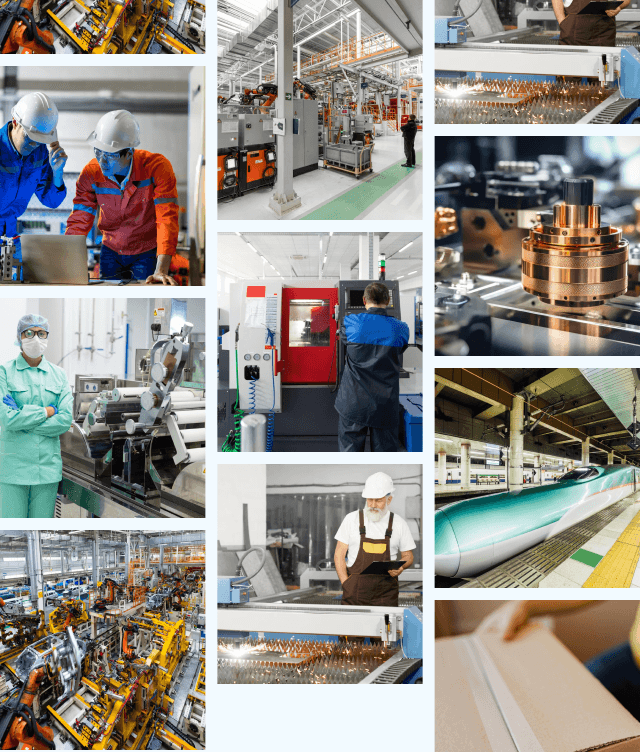
- Automotive industry
- Automotive supply industry
- Commercial vehicle industry
- Aerospace industry
- Construction machinery and agricultural machinery industry
- Defense industry
- Shipping industry
- Mechanical and plant engineering
- Pharmaceutical, chemical industry, and medical technology
- Food industry
- Construction industry
- Railway industry
Schedule an appointment
We would be happy to present our product to you in a video conference or
a personal appointment.